 Mitlesen
Hänsel und Gretel
Hansel and Gretel
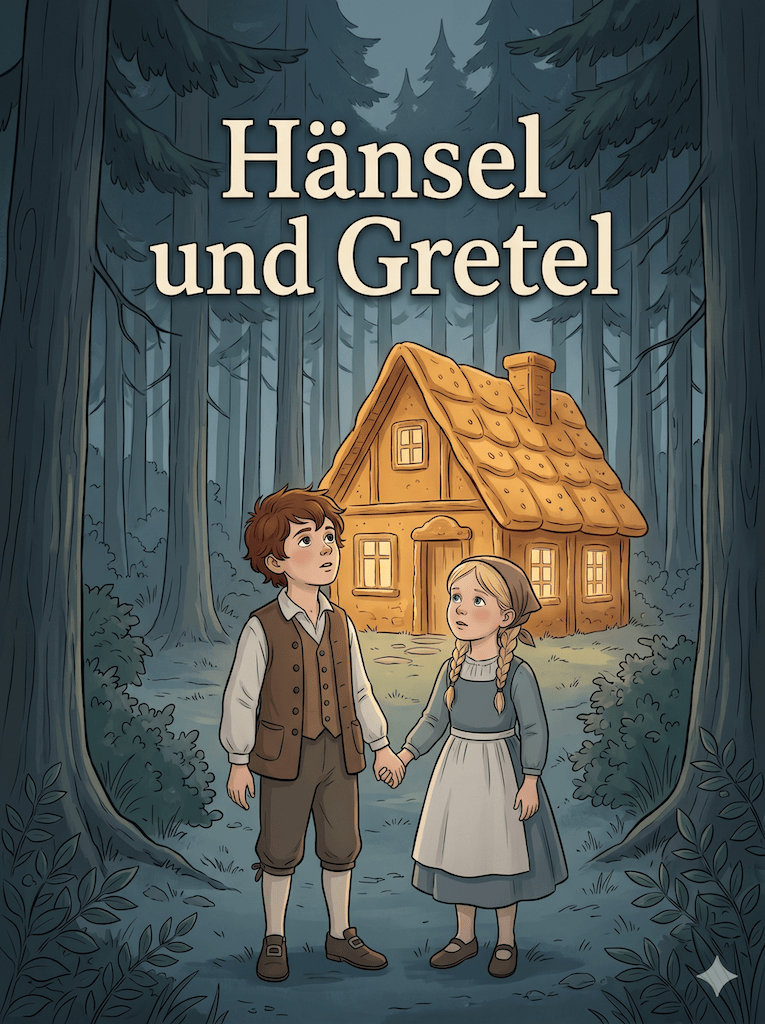
During a severe famine, a poor woodcutter and his wife abandon their children, Hansel and Gretel, in the depths of a dark forest. Lost and starving, the siblings discover a house made entirely of bread, cake, and sugar. They begin eating the house but are caught by its owner, an old witch who plans to fatten up Hansel and eat him. Gretel eventually outsmarts the witch by tricking her into her own oven, allowing the children to escape with her treasure and reunite with their father.
Hänsel und Gretel in English
Vor einem großen Wald wohnt ein armer Holzhacker. Er lebt mit seiner Frau und seinen zwei Kindern. Der Junge heißt Hänsel.
In front of a big forest lives a poor woodcutter. He lives with his wife and his two children. The boy is called Hänsel.
Das Mädchen heißt Gretel.
The girl is called Gretel.
Sie haben wenig zu essen. Dann kommt eine große Not ins Land. Der Mann hat nicht einmal mehr Brot.
They have little to eat. Then a great hardship comes to the land. The man does not even have bread anymore.
Am Abend liegt der Mann im Bett. Er hat große Sorgen und sagt zu seiner Frau: „Was sollen wir nur tun?“
In the evening the man lies in bed. He has big worries and says to his wife: “What should we do?”
Die Frau sagt: „Wir bringen die Kinder in den Wald.“ „Wir machen ein Feuer und geben jedem ein Stück Brot.“ „Dann gehen wir weg. Die Kinder finden den Weg nicht mehr.“
The woman says: “We will take the children into the forest.” “We will make a fire and give each one a piece of bread.” “Then we will go away. The children will not find the way anymore.”
„Nein, Frau“, sagt der Mann. „Das tue ich nicht.“ „Ich lasse meine Kinder nicht allein im Wald.“ „Die wilden Tiere fressen sie.“
“No, wife,” says the man. “I will not do that.” “I will not leave my children alone in the forest.” “The wild animals will eat them.”
„Dann sterben wir alle vier vor Hunger“, sagt die Frau. Sie redet immer weiter, bis der Mann Ja sagt.
“Then all four of us will die of hunger,” says the woman. She keeps talking until the man says yes.
„Aber die armen Kinder tun mir leid“, sagt der Mann. Er hat Mitleid mit Hänsel und Gretel.
“But I feel sorry for the poor children,” says the man. He feels pity for Hänsel and Gretel.
Die zwei Kinder schlafen nicht. Sie haben Hunger. Sie hören den Plan der Stiefmutter.
The two children are not sleeping. They are hungry. They hear the stepmother's plan.
Gretel weint und sagt: „Jetzt ist alles aus.“
Gretel cries and says: “Now everything is over.”
„Sei still, Gretel“, sagt Hänsel. „Weine nicht. Ich helfe uns.“
“Be quiet, Gretel,” says Hänsel. “Do not cry. I will help us.”
Die Eltern schlafen. Hänsel steht leise auf. Er geht aus dem Haus.
The parents are sleeping. Hänsel gets up quietly. He goes out of the house.
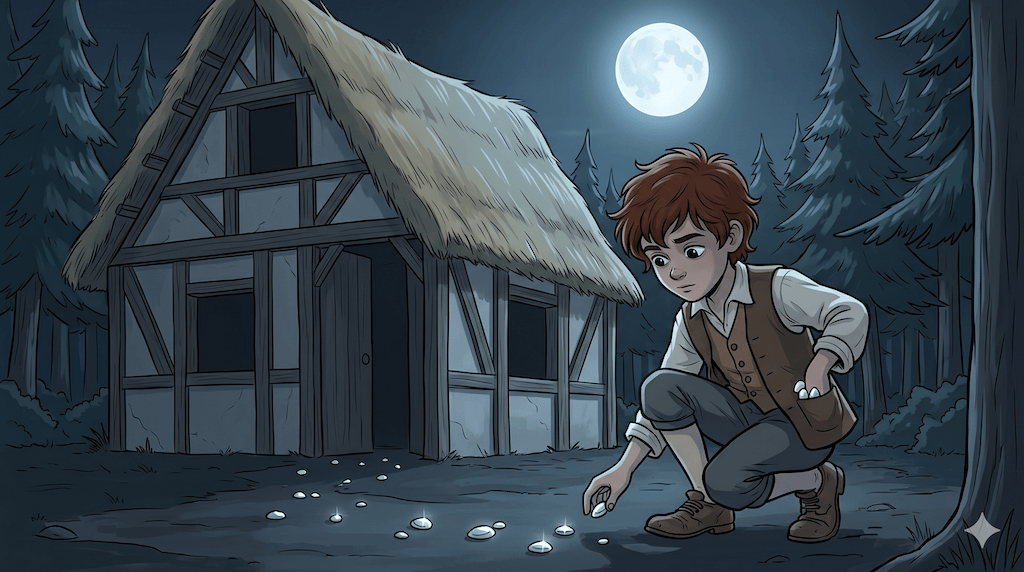
Der Mond scheint hell. Die weißen Steine glänzen wie Münzen.
The moon shines bright. The white stones glisten like coins.
Hänsel nimmt viele Steine. Er steckt sie in seine Tasche.
Hänsel takes many stones. He puts them in his pocket.
Dann geht Hänsel zurück und sagt zu Gretel: „Schlaf ruhig. Gott lässt uns nicht allein.“ Dann legt er sich wieder ins Bett.
Then Hänsel goes back and says to Gretel: “Sleep calmly. God will not leave us alone.” Then he lies down in bed again.
Am Morgen weckt die Frau die Kinder. „Steht auf! Wir gehen in den Wald und holen Holz.“
In the morning the woman wakes the children. “Get up! We are going into the forest to fetch wood.”
Sie gibt jedem ein Stück Brot und sagt: „Das ist für den Mittag. Esst es nicht zu früh.“
She gives each one a piece of bread and says: “That is for lunch. Do not eat it too early.”
Gretel nimmt das Brot unter ihre Schürze. Denn Hänsels Tasche ist voll mit Steinen. Dann gehen alle zusammen in den Wald.
Gretel takes the bread under her apron. Because Hänsel's pocket is full of stones. Then they all go into the forest together.
Hänsel bleibt oft stehen. Er schaut zum Haus zurück. Der Vater fragt: „Hänsel, warum bleibst du zurück?“
Hänsel often stops. He looks back at the house. The father asks: “Hänsel, why are you falling behind?”
„Ich schaue zu meiner weißen Katze“, sagt Hänsel. „Sie sitzt auf dem Dach und sagt mir Lebewohl.“
“I am looking at my white cat,” says Hänsel. “She sits on the roof and says goodbye to me.”
„Das ist nicht die Katze“, sagt die Frau. „Das ist die Morgensonne auf dem Dach.“
“That is not the cat,” says the woman. “That is the morning sun on the roof.”
Aber Hänsel schaut nicht zur Katze. Er wirft immer einen weißen Stein auf den Weg.
But Hänsel is not looking at the cat. He keeps throwing a white stone onto the path.
Sie kommen tief in den Wald. Der Vater sagt: „Sammelt Holz, Kinder.“ „Ich mache ein Feuer, dann friert ihr nicht.“
They come deep into the forest. The father says: “Gather wood, children.” “I will make a fire, then you will not be cold.”
Hänsel und Gretel sammeln viel Holz. Der Vater macht ein Feuer. Die Flamme brennt hoch.
Hänsel and Gretel gather a lot of wood. The father makes a fire. The flame burns high.
Die Frau sagt: „Ruht euch am Feuer aus.“ „Wir hauen Holz im Wald.“ „Später kommen wir wieder und holen euch.“
The woman says: “Rest by the fire.” “We are chopping wood in the forest.” “Later we will come back and fetch you.”
Am Mittag essen die Kinder ihr Brot. Sie hören Schläge und denken: Der Vater ist nah.
At noon the children eat their bread. They hear blows and think: Father is near.
Aber es ist nicht die Axt. Es ist ein Ast. Der Wind schlägt ihn an einen Baum.
But it is not the axe. It is a branch. The wind beats it against a tree.
Die Kinder sind müde und schlafen ein.
The children are tired and fall asleep.
Sie wachen auf. Es ist dunkle Nacht. Gretel hat Angst und weint.
They wake up. It is dark night. Gretel is scared and cries.
„Wie kommen wir aus dem Wald?“, fragt sie.
“How do we get out of the forest?” she asks.
Hänsel sagt: „Warte ein wenig.“ „Dann kommt der Mond, und wir finden den Weg.“
Hänsel says: “Wait a little.” “Then the moon will come, and we will find the way.”
Der volle Mond kommt. Hänsel nimmt Gretels Hand. Die weißen Steine glänzen und zeigen den Weg.
The full moon comes. Hänsel takes Gretel's hand. The white stones glisten and show the way.
Sie gehen die ganze Nacht. Am Morgen sind sie wieder beim Haus des Vaters.
They walk the whole night. In the morning they are back at the father's house.
Sie klopfen an die Tür. Die Frau öffnet. „Ihr bösen Kinder! Warum schlaft ihr so lange im Wald?“
They knock on the door. The woman opens it. “You bad children! Why did you sleep so long in the forest?”
Der Vater aber freut sich sehr. Es war ihm schwer, die Kinder allein zu lassen.
But the father is very glad. It had been hard for him to leave the children alone.
Vor einem großen Wald wohnt ein armer Holzhacker. Er lebt dort mit seiner Frau und seinen zwei Kindern. Der Junge heißt Hänsel und das Mädchen heißt Gretel.
In front of a big forest lives a poor woodcutter. He lives there with his wife and his two children. The boy is called Hänsel and the girl is called Gretel.
Sie haben sehr wenig zu essen. Dann kommt eine große Hungersnot ins Land. Jetzt hat der Vater nicht einmal mehr Brot für jeden Tag.
They have very little to eat. Then a great famine comes to the land. Now the father does not even have bread for every day anymore.
Eines Abends hat der Vater große Sorgen. Er sagt zu seiner Frau: „Was sollen wir nur machen?“ „Wir haben kein Essen mehr für unsere Kinder.“
One evening the father has big worries. He says to his wife: “What are we going to do?” “We have no more food for our children.”
Die Frau antwortet: „Ich weiß etwas, Mann.“ „Morgen früh bringen wir die Kinder tief in den Wald.“ „Dort machen wir ein Feuer und geben jedem ein Stück Brot.“
The woman answers: “I know something, husband.” “Tomorrow morning we will take the children deep into the forest.” “There we will make a fire and give each one a piece of bread.”
„Dann gehen wir weg und lassen die Kinder allein.“ „Sie finden den Weg nach Hause nicht mehr.“ „So sind wir die Kinder los.“
“Then we will go away and leave the children alone.” “They will not find the way home anymore.” “That way we will be rid of the children.”
Der Mann sagt: „Nein, Frau, das mache ich nicht.“ „Ich kann meine Kinder nicht allein im Wald lassen.“ „Die wilden Tiere kommen und fressen sie.“
The man says: “No, wife, I will not do that.” “I cannot leave my children alone in the forest.” “The wild animals will come and eat them.”
„Du bist dumm“, sagt die Frau. „Dann sterben wir alle vier vor Hunger.“ Sie lässt ihm keine Ruhe, bis er Ja sagt.
“You are foolish,” says the woman. “Then all four of us will die of hunger.” She gives him no peace until he says yes.
Aber die armen Kinder tun dem Mann sehr leid.
But the man feels very sorry for the poor children.
Die zwei Kinder können vor Hunger nicht schlafen. Darum hören sie alles, was die Stiefmutter sagt. Gretel weint und sagt zu Hänsel: „Jetzt ist es aus mit uns.“
The two children cannot sleep because of hunger. So they hear everything that the stepmother says. Gretel cries and says to Hänsel: “Now it is over for us.”
„Sei still, Gretel“, sagt Hänsel. „Hab keine Angst, ich helfe uns.“
“Be quiet, Gretel,” says Hänsel. “Do not be afraid, I will help us.”
In der Nacht schlafen die Eltern. Da steht Hänsel leise auf und geht vor die Tür. Der Mond scheint hell, und die weißen Steine glänzen wie Geld.
In the night the parents are sleeping. Then Hänsel gets up quietly and goes outside the door. The moon shines bright, and the white stones glisten like money.
Hänsel nimmt viele kleine Steine. Er steckt so viele Steine in seine Tasche, wie hineinpassen.
Hänsel takes many small stones. He puts as many stones into his pocket as will fit.
Dann geht Hänsel zurück und sagt zu Gretel: „Schlaf ruhig, liebe Schwester, Gott lässt uns nicht allein.“ Danach legt er sich wieder ins Bett.
Then Hänsel goes back and says to Gretel: “Sleep calmly, dear sister, God will not leave us alone.” After that he lies down in bed again.
Am Morgen weckt die Frau die beiden Kinder. Sie sagt: „Steht auf, wir gehen in den Wald und holen Holz.“
In the morning the woman wakes the two children. She says: “Get up, we are going into the forest to fetch wood.”
Dann gibt sie jedem Kind ein Stück Brot. „Das ist euer Essen für den Mittag“, sagt sie. „Esst es nicht zu früh, mehr bekommt ihr nicht.“
Then she gives each child a piece of bread. “That is your food for lunch,” she says. “Do not eat it too early, you will not get any more.”
Gretel trägt das Brot unter ihrer Schürze. Denn Hänsels Tasche ist voll mit Steinen. Dann gehen alle zusammen in den Wald.
Gretel carries the bread under her apron. Because Hänsel's pocket is full of stones. Then they all go into the forest together.
Hänsel bleibt oft stehen und schaut zum Haus zurück. Der Vater fragt: „Hänsel, warum bleibst du stehen?“ „Komm weiter und pass auf den Weg auf.“
Hänsel often stops and looks back at the house. The father asks: “Hänsel, why do you stop?” “Come on and watch the path.”
„Ach, Vater“, sagt Hänsel. „Ich schaue nach meiner weißen Katze auf dem Dach.“ „Sie will mir Tschüss sagen.“
“Oh, father,” says Hänsel. “I am looking at my white cat on the roof.” “She wants to say goodbye to me.”
Die Frau sagt: „Dummkopf, das ist nicht deine Katze.“ „Das ist die Morgensonne auf dem Schornstein.“
The woman says: “Silly boy, that is not your cat.” “That is the morning sun on the chimney.”
Aber Hänsel hat gar nicht nach der Katze geschaut. Er hat immer wieder einen weißen Stein auf den Weg gelegt.
But Hänsel was not looking at the cat at all. He kept laying a white stone on the path again and again.
Tief im Wald sagt der Vater: „Sammelt Holz, Kinder.“ „Ich mache ein Feuer, dann friert ihr nicht.“
Deep in the forest the father says: “Gather wood, children.” “I will make a fire, then you will not be cold.”
Hänsel und Gretel sammeln viel Holz. Der Vater macht ein Feuer, und bald brennt es hoch.
Hänsel and Gretel gather a lot of wood. The father makes a fire, and soon it burns high.
Dann sagt die Frau: „Ruht euch hier am Feuer aus, Kinder.“ „Wir gehen in den Wald und hacken Holz.“ „Danach kommen wir zurück und holen euch ab.“
Then the woman says: “Rest here by the fire, children.” “We are going into the forest to chop wood.” “After that we will come back and fetch you.”
Am Mittag isst jedes Kind sein Stück Brot. Sie hören Schläge und denken: „Der Vater ist nah.“
At noon each child eats its piece of bread. They hear blows and think: “Father is near.”
Aber es ist nicht der Vater mit der Axt. Es ist nur ein Ast, den der Wind gegen einen Baum schlägt. Die Kinder sind müde und schlafen fest ein.
But it is not the father with the axe. It is only a branch that the wind beats against a tree. The children are tired and fall fast asleep.
Als sie aufwachen, ist es schon dunkle Nacht. Gretel hat Angst und weint: „Wie kommen wir aus dem Wald?“
When they wake up, it is already dark night. Gretel is scared and cries: “How do we get out of the forest?”
Hänsel sagt: „Warte ein bisschen, bis der Mond kommt.“ „Dann finden wir den Weg.“
Hänsel says: “Wait a bit, until the moon comes.” “Then we will find the way.”
Als der volle Mond am Himmel ist, nimmt Hänsel Gretels Hand. Die weißen Steine glänzen und zeigen ihnen den Weg.
When the full moon is in the sky, Hänsel takes Gretel's hand. The white stones glisten and show them the way.
Sie gehen die ganze Nacht durch den Wald. Am Morgen kommen sie wieder zum Haus des Vaters.
They walk the whole night through the forest. In the morning they come back to the father's house.
Die Frau öffnet die Tür und sieht die Kinder. Sie schimpft: „Warum habt ihr so lange im Wald geschlafen?“ „Wir haben gedacht, ihr kommt nicht mehr zurück.“
The woman opens the door and sees the children. She scolds: “Why did you sleep so long in the forest?” “We thought you would not come back anymore.”
Der Vater aber freut sich sehr über die Kinder. Denn es war traurig für ihn, dass er sie allein gelassen hat.
But the father is very glad about the children. Because it had been sad for him that he left them alone.
Vor einem großen Wald wohnte ein armer Holzfäller mit seiner Frau und seinen zwei Kindern. Der Junge hieß Hänsel und das Mädchen hieß Gretel. Die Familie hatte nur wenig zu essen. Als eine große Hungersnot ins Land kam, konnte der Vater nicht einmal mehr genug Brot für jeden Tag kaufen.
In front of a big forest lived a poor woodcutter with his wife and his two children. The boy was called Hänsel and the girl was called Gretel. The family had only little to eat. When a great famine came to the land, the father could no longer even buy enough bread for every day.
Eines Abends lag der Vater voller Sorgen im Bett und konnte nicht schlafen. Er seufzte und fragte seine Frau: „Was soll nur aus uns werden?“ „Wie sollen wir unsere armen Kinder ernähren, wenn wir selbst nichts mehr zu essen haben?“
One evening the father lay in bed full of worries and could not sleep. He sighed and asked his wife: “What is going to become of us?” “How are we supposed to feed our poor children when we ourselves have nothing left to eat?”
„Hör mir zu, Mann“, antwortete die Frau. „Morgen früh bringen wir die Kinder tief in den Wald, dorthin, wo er am dichtesten ist.“ „Wir machen ihnen ein Feuer und geben jedem ein Stück Brot.“ „Dann gehen wir zur Arbeit und lassen sie allein, damit sie den Weg nach Hause nicht mehr finden.“
“Listen to me, husband,” the woman answered. “Tomorrow morning we will take the children deep into the forest, to where it is thickest.” “We will make them a fire and give each one a piece of bread.” “Then we will go to work and leave them alone, so that they cannot find the way home anymore.”
„Nein, Frau“, sagte der Mann, „das mache ich nicht.“ „Wie könnte ich es nur übers Herz bringen, meine Kinder allein im Wald zu lassen?“ „Die wilden Tiere würden bald kommen und sie fressen.“
“No, wife,” said the man, “I will not do that.” “How could I ever bring myself to leave my children alone in the forest?” “The wild animals would soon come and eat them.”
„Du Dummkopf“, sagte die Frau, „dann müssen wir eben alle vier verhungern.“ Sie ließ ihm keine Ruhe und redete so lange auf ihn ein, bis er schließlich nachgab. „Aber die armen Kinder tun mir trotzdem leid“, sagte der Mann traurig.
“You fool,” said the woman, “then all four of us will simply have to starve.” She gave him no peace and talked at him so long that he finally gave in. “But I still feel sorry for the poor children,” said the man sadly.
Die beiden Kinder konnten vor Hunger nicht einschlafen. So hörten sie alles, was die Stiefmutter zum Vater sagte. Gretel weinte bittere Tränen und sprach zu Hänsel: „Jetzt ist alles aus mit uns.“
The two children could not fall asleep because of hunger. So they heard everything that the stepmother said to the father. Gretel cried bitter tears and said to Hänsel: “Now it is all over for us.”
„Sei still, Gretel“, flüsterte Hänsel, „und mach dir keine Sorgen.“ „Ich finde schon einen Weg, der uns hilft.“
“Be quiet, Gretel,” whispered Hänsel, “and do not worry.” “I will surely find a way that helps us.”
Als die Eltern eingeschlafen waren, stand Hänsel leise auf. Er zog seine Jacke an und schlich aus dem Haus. Der Mond schien ganz hell, und die weißen Kieselsteine vor dem Haus glänzten wie lauter Münzen. Hänsel bückte sich und steckte so viele Steine in seine Tasche, wie nur hineinpassten.
When the parents had fallen asleep, Hänsel got up quietly. He put on his jacket and crept out of the house. The moon shone quite bright, and the white pebbles in front of the house glistened like so many coins. Hänsel bent down and put as many stones into his pocket as would fit.
Dann ging er wieder ins Haus zurück und sprach zu Gretel: „Schlaf ganz ruhig, liebe Schwester. Gott wird uns nicht verlassen.“ Danach legte er sich wieder in sein Bett.
Then he went back into the house and said to Gretel: “Sleep quite calmly, dear sister. God will not abandon us.” After that he lay down in his bed again.
Als der Morgen kam, weckte die Frau die beiden Kinder. „Steht auf, ihr Faulpelze“, rief sie, „wir gehen in den Wald und holen Holz.“
When morning came, the woman woke the two children. “Get up, you lazybones,” she called, “we are going into the forest to fetch wood.”
Dann gab sie jedem ein kleines Stück Brot. „Das ist euer Essen für den Mittag“, sagte sie, „aber esst es nicht zu früh, mehr bekommt ihr nicht.“ Gretel steckte das Brot unter ihre Schürze, denn Hänsels Tasche war voll mit Steinen.
Then she gave each one a small piece of bread. “That is your food for lunch,” she said, “but do not eat it too early, you will not get any more.” Gretel put the bread under her apron, because Hänsel's pocket was full of stones.
Dann machten sich alle zusammen auf den Weg in den Wald. Nach einer kurzen Weile blieb Hänsel stehen und schaute zum Haus zurück. Das tat er immer wieder.
Then they all set out together on the way into the forest. After a short while Hänsel stopped and looked back at the house. He did that again and again.
Der Vater fragte: „Hänsel, warum bleibst du stehen und schaust zurück?“ „Pass lieber auf den Weg auf.“
The father asked: “Hänsel, why do you stop and look back?” “You had better watch the path.”
„Ach, Vater“, sagte Hänsel, „ich schaue nach meiner weißen Katze.“ „Sie sitzt oben auf dem Dach und will mir Lebewohl sagen.“
“Oh, father,” said Hänsel, “I am looking at my white cat.” “She is sitting up there on the roof and wants to say farewell to me.”
„Du Dummkopf“, sagte die Frau, „das ist nicht deine Katze.“ „Das ist die Morgensonne, die auf den Schornstein scheint.“
“You fool,” said the woman, “that is not your cat.” “That is the morning sun shining on the chimney.”
Aber Hänsel hatte gar nicht nach der Katze geschaut. In Wahrheit warf er heimlich einen Kieselstein nach dem anderen aus seiner Tasche auf den Weg.
But Hänsel had not been looking at the cat at all. In truth he was secretly throwing one pebble after another out of his pocket onto the path.
Als sie tief im Wald angekommen waren, sagte der Vater: „Sammelt jetzt Holz, Kinder, dann mache ich ein Feuer, damit ihr nicht friert.“
When they had arrived deep in the forest, the father said: “Now gather wood, children, then I will make a fire so that you do not get cold.”
Hänsel und Gretel trugen viele trockene Äste zusammen, bis ein kleiner Berg daraus wurde. Der Vater zündete das Holz an, und bald brannte das Feuer hoch.
Hänsel and Gretel carried together many dry branches, until a small mountain was made of them. The father lit the wood, and soon the fire burned high.
Dann sagte die Frau: „Legt euch ans Feuer, Kinder, und ruht euch aus.“ „Wir gehen in den Wald und hacken Holz.“ „Wenn wir fertig sind, kommen wir zurück und holen euch ab.“
Then the woman said: “Lie down by the fire, children, and rest.” “We are going into the forest to chop wood.” “When we are done, we will come back and fetch you.”
Hänsel und Gretel saßen am Feuer, und als es Mittag wurde, aß jedes sein Stück Brot. Sie hörten Schläge wie von einer Axt und glaubten, ihr Vater wäre in der Nähe.
Hänsel and Gretel sat by the fire, and when it became noon, each ate its piece of bread. They heard blows like an axe and believed their father was nearby.
Aber es war gar keine Axt. Es war nur ein Ast, den der Wind immer wieder gegen einen Baum schlug. Endlich wurden die Kinder müde, ihre Augen fielen zu, und sie schliefen fest ein.
But it was no axe at all. It was only a branch that the wind kept beating against a tree. At last the children grew tired, their eyes closed, and they fell fast asleep.
Als sie aufwachten, war es schon dunkle Nacht. Gretel bekam Angst und weinte: „Wie sollen wir jetzt aus dem Wald herauskommen?“
When they woke up, it was already dark night. Gretel became afraid and cried: “How are we supposed to get out of the forest now?”
Aber Hänsel tröstete sie und sagte: „Warte nur ein wenig, bis der Mond aufgegangen ist, dann finden wir den Weg schon.“
But Hänsel comforted her and said: “Just wait a little, until the moon has risen, then we will surely find the way.”
Als der volle Mond am Himmel stand, nahm Hänsel seine Schwester an der Hand. Sie folgten den Kieselsteinen, die im Mondlicht wie frische Münzen glänzten und ihnen den Weg zeigten. Sie gingen die ganze Nacht und kamen am frühen Morgen wieder beim Haus ihres Vaters an.
When the full moon stood in the sky, Hänsel took his sister by the hand. They followed the pebbles, which glistened in the moonlight like fresh coins and showed them the way. They walked the whole night and arrived back at their father's house in the early morning.
Sie klopften an die Tür. Als die Frau öffnete und die Kinder sah, schimpfte sie: „Ihr bösen Kinder, warum habt ihr so lange im Wald geschlafen?“ „Wir dachten schon, ihr wollt gar nicht mehr zurückkommen.“
They knocked on the door. When the woman opened it and saw the children, she scolded: “You bad children, why did you sleep so long in the forest?” “We already thought you did not want to come back at all.”
Der Vater aber freute sich sehr. Es hatte ihm nämlich im Herzen wehgetan, dass er die Kinder allein im Wald gelassen hatte.
But the father was very glad. For it had hurt him in his heart that he had left the children alone in the forest.
Vor einem großen Wald wohnte ein armer Holzhacker mit seiner Frau und seinen zwei Kindern. Der Junge hieß Hänsel und das Mädchen Gretel. Die Familie hatte nur wenig zu essen. Als eine große Hungersnot ins Land kam, konnte der Vater nicht einmal mehr das tägliche Brot beschaffen.
In front of a great forest lived a poor woodcutter with his wife and his two children. The boy was called Hänsel and the girl Gretel. The family had only little to eat. When a great famine came to the land, the father could no longer even provide the daily bread.
Eines Abends lag der Mann voller Sorgen im Bett und konnte nicht schlafen. Er seufzte und sagte zu seiner Frau: „Was soll nur aus uns werden?“ „Wie sollen wir unsere armen Kinder ernähren, wenn wir für uns selbst nichts mehr haben?“
One evening the man lay in bed full of worries and could not sleep. He sighed and said to his wife: “What is going to become of us?” “How are we to feed our poor children when we have nothing left for ourselves?”
„Weißt du was, Mann“, antwortete die Frau, „morgen früh bringen wir die Kinder tief in den Wald, dorthin, wo er am dichtesten ist.“ „Dort machen wir ihnen ein Feuer an und geben jedem ein Stückchen Brot.“ „Dann gehen wir an unsere Arbeit und lassen sie allein.“ „Sie finden den Weg nicht wieder nach Hause, und so sind wir sie los.“
“You know what, husband,” the woman answered, “tomorrow morning we will take the children deep into the forest, to where it is thickest.” “There we will light them a fire and give each one a little piece of bread.” “Then we will go off to our work and leave them alone.” “They will not find the way home again, and so we will be rid of them.”
„Nein, Frau“, sagte der Mann, „das tue ich nicht.“ „Wie sollte ich es übers Herz bringen, meine Kinder allein im Wald zu lassen?“ „Die wilden Tiere würden bald kommen und sie zerreißen.“
“No, wife,” said the man, “I will not do that.” “How could I bring myself to leave my children alone in the forest?” “The wild animals would soon come and tear them apart.”
„Oh, du Narr“, sagte sie, „dann müssen wir alle vier vor Hunger sterben.“ „Du kannst ja schon die Bretter für die Särge hobeln.“ Und sie ließ ihm keine Ruhe, bis er einwilligte. „Aber die armen Kinder tun mir doch leid“, sagte der Mann.
“Oh, you fool,” she said, “then all four of us will have to die of hunger.” “You may as well plane the boards for the coffins.” And she gave him no peace until he consented. “But I do feel sorry for the poor children,” said the man.
Die beiden Kinder hatten vor Hunger nicht einschlafen können. So hörten sie, was die Stiefmutter zum Vater sagte. Gretel weinte bittere Tränen und sprach zu Hänsel: „Nun ist es um uns geschehen.“ „Sei still, Gretel“, sagte Hänsel, „mach dir keine Sorgen, ich helfe uns schon.“
The two children had not been able to fall asleep because of hunger. So they heard what the stepmother said to the father. Gretel cried bitter tears and said to Hänsel: “Now it is all over for us.” “Be quiet, Gretel,” said Hänsel, “do not worry, I will surely help us.”
Als die Eltern eingeschlafen waren, stand er auf, zog seine Jacke an und schlich sich aus dem Haus. Der Mond schien ganz hell, und die weißen Kieselsteine vor dem Haus glänzten wie lauter Münzen. Hänsel bückte sich und steckte so viele Steine in seine Tasche, wie nur hineinpassten.
When the parents had fallen asleep, he got up, put on his jacket and crept out of the house. The moon shone quite bright, and the white pebbles in front of the house glistened like so many coins. Hänsel bent down and put as many stones into his pocket as would fit.
Dann ging er wieder zurück und sagte zu Gretel: „Sei ruhig, liebes Schwesterchen, und schlaf nur friedlich ein.“ „Gott wird uns nicht verlassen.“ Und er legte sich wieder in sein Bett.
Then he went back and said to Gretel: “Be calm, dear little sister, and just fall peacefully asleep.” “God will not abandon us.” And he lay down in his bed again.
Als der Tag anbrach, kam die Frau und weckte die beiden Kinder: „Steht auf, ihr Faulenzer, wir wollen in den Wald gehen und Holz holen.“ Dann gab sie jedem ein Stückchen Brot und sagte: „Da habt ihr etwas für den Mittag, aber esst es nicht vorher auf, mehr bekommt ihr nicht.“
When day broke, the woman came and woke the two children: “Get up, you idlers, we want to go into the forest and fetch wood.” Then she gave each one a little piece of bread and said: “There you have something for lunch, but do not eat it up before then, you will not get any more.”
Gretel nahm das Brot unter ihre Schürze, weil Hänsel die Steine in der Tasche trug. Dann machten sie sich alle zusammen auf den Weg in den Wald. Als sie eine Weile gegangen waren, blieb Hänsel stehen und schaute immer wieder zum Haus zurück.
Gretel took the bread under her apron, because Hänsel carried the stones in his pocket. Then they all set out together on the way into the forest. When they had walked for a while, Hänsel stopped and kept looking back at the house.
Der Vater sagte: „Hänsel, was schaust du da und bleibst zurück?“ „Pass auf und beweg deine Beine.“
The father said: “Hänsel, what are you looking at there, falling behind?” “Pay attention and get a move on.”
„Ach, Vater“, sagte Hänsel, „ich schaue nach meinem weißen Kätzchen, das oben auf dem Dach sitzt und mir Lebewohl sagen will.“ „Du Narr“, sagte die Frau, „das ist nicht dein Kätzchen, das ist die Morgensonne, die auf den Schornstein scheint.“ Hänsel hatte aber gar nicht nach dem Kätzchen geschaut. Jedes Mal hatte er heimlich einen von den blanken Kieselsteinen aus seiner Tasche auf den Weg geworfen.
“Oh, father,” said Hänsel, “I am looking at my white kitten, which is sitting up on the roof and wants to say farewell to me.” “You fool,” said the woman, “that is not your kitten, that is the morning sun shining on the chimney.” But Hänsel had not been looking at the kitten at all. Each time he had secretly thrown one of the shiny pebbles from his pocket onto the path.
Als sie mitten in den Wald gekommen waren, sagte der Vater: „Nun sammelt Holz, ihr Kinder, ich will ein Feuer anmachen, damit ihr nicht friert.“ Hänsel und Gretel trugen Reisig zusammen, einen kleinen Berg hoch. Das Reisig wurde angezündet, und bald brannte die Flamme hoch.
When they had come to the middle of the forest, the father said: “Now gather wood, children, I want to light a fire so that you do not get cold.” Hänsel and Gretel carried together brushwood, as high as a small mountain. The brushwood was lit, and soon the flame burned high.
Da sagte die Frau: „Nun legt euch ans Feuer, ihr Kinder, und ruht euch aus.“ „Wir gehen in den Wald und hacken Holz.“ „Wenn wir fertig sind, kommen wir wieder und holen euch ab.“
Then the woman said: “Now lie down by the fire, children, and rest.” “We are going into the forest to chop wood.” “When we are done, we will come back and fetch you.”
Hänsel und Gretel saßen am Feuer, und als der Mittag kam, aß jedes sein Stückchen Brot. Weil sie die Schläge der Holzaxt hörten, glaubten sie, ihr Vater wäre in der Nähe. Es war aber nicht die Axt, sondern ein Ast, den der Wind gegen einen dürren Baum schlug. Endlich fielen ihnen vor Müdigkeit die Augen zu, und sie schliefen fest ein.
Hänsel and Gretel sat by the fire, and when noon came, each ate its little piece of bread. Because they heard the blows of the wood axe, they believed their father was nearby. But it was not the axe, it was a branch that the wind beat against a withered tree. At last, out of weariness, their eyes closed, and they fell fast asleep.
Als sie aufwachten, war es schon finstere Nacht. Gretel fing an zu weinen und sagte: „Wie sollen wir jetzt aus dem Wald herauskommen?“ Hänsel aber tröstete sie: „Warte nur eine Weile, bis der Mond aufgegangen ist, dann finden wir den Weg schon.“
When they woke up, it was already pitch-dark night. Gretel began to cry and said: “How are we supposed to get out of the forest now?” But Hänsel comforted her: “Just wait a while, until the moon has risen, then we will surely find the way.”
You have read the first 30% of Hänsel und Gretel.
Continue in the app
This is the free opening. The rest — with audio, flashcards and translations in Persian, Turkish and Arabic — is in the app.
Every German sentence is paired with its English translation — read the German on its own, or check the English line by line. The opening is free to read here; the full story continues in the app, where it also reads in Persian, Turkish and Arabic.