 Mitlesen
Sonntag ist Ruhetag
Sunday Is a Day of Rest
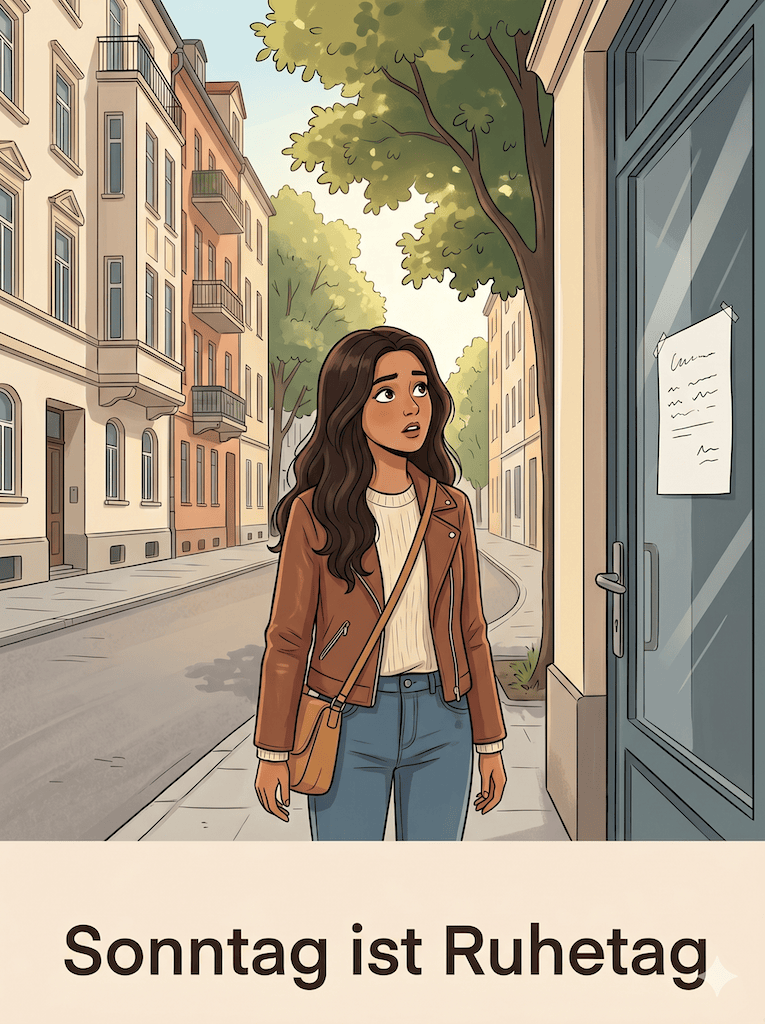
Giulia (20), an exchange student from Turin, is alone in Munich for her first weekend — her host family is away. She planned to cook pasta but went to the Alps on Saturday and forgot to shop. Sunday, 10 AM. Edeka: closed. DM: closed. Bäckerei: closed. The gas station is open but only sells chocolate, chips, and beer. Hungry and furious, she knocks on the neighbor's door. Frau Schmidt (80) looks at her like she has two heads — then lets her in. Coffee and cake (“den habe ich gestern gebacken, natürlich”), a lesson on Sonntagsruhe, and a bag of bread, cheese, and eggs. “Komm jeden Sonntag, Kind. Allein essen ist nicht gut.” The next Sunday, Giulia brings Italian cookies.
Sonntag ist Ruhetag auf Englisch
Giulia ist zwanzig Jahre alt. Sie kommt aus Turin. Sie lebt seit zwei Wochen in München.
Giulia is twenty years old. She is from Turin. She has been living in Munich for two weeks.
Sie wohnt bei Familie Huber in Schwabing. Sie studiert hier ein Semester.
She lives with the Huber family in Schwabing. She is studying here for one semester.
Am Freitag sagt Frau Huber: „Wir fahren am Wochenende zum Bodensee.“ „Wir kommen am Sonntagabend zurück.“ „Du bist allein im Haus.“
On Friday Frau Huber says: “We are going to Lake Constance this weekend.” “We will be back on Sunday evening.” “You will be alone in the house.”
Giulia freut sich. Zwei Tage allein!
Giulia is happy. Two days alone!
Am Samstag fährt sie mit dem Programm in die Alpen. Es ist ein schöner Tag.
On Saturday she goes to the Alps with her program. It is a beautiful day.
Am Abend ist sie müde. Sie denkt: Morgen koche ich Pasta. Ich kaufe morgen früh ein.
In the evening she is tired. She thinks: Tomorrow I will cook pasta. I will go shopping tomorrow morning.
Am Sonntag steht Giulia um zehn Uhr auf. Sie hat Hunger.
On Sunday Giulia gets up at ten o’clock. She is hungry.
Im Kühlschrank sind nur ein Joghurt und drei Eier. Sie zieht ihre Jacke an. Sie geht zu Edeka.
In the fridge there are only one yogurt and three eggs. She puts on her jacket. She goes to Edeka.
Edeka ist zu.
Edeka is closed.
Dann geht sie zu DM. DM verkauft auch Lebensmittel. Aber DM ist auch zu.
Then she goes to DM. DM also sells food. But DM is also closed.
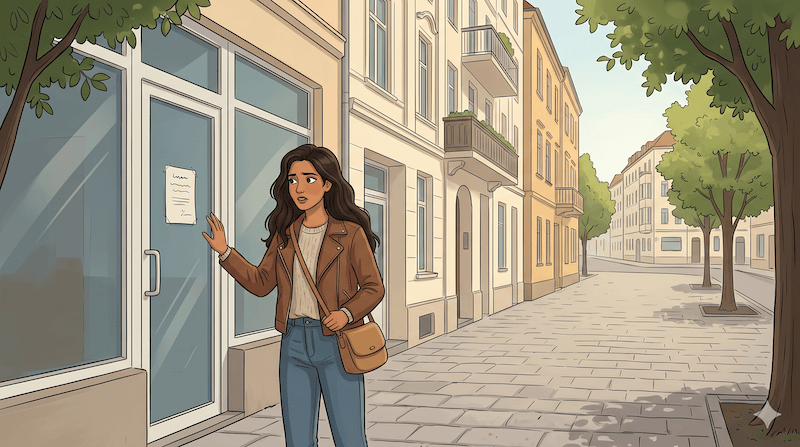
Sie geht zur Bäckerei an der Ecke. An der Tür steht: „Sonntag: 8 bis 10 Uhr.“ Es ist schon halb elf.
She goes to the bakery on the corner. On the door it says: “Sunday: 8 to 10.” It is already half past ten.
Giulia bleibt vor der Tür stehen. Sie versteht nicht.
Giulia stops in front of the door. She does not understand.
Eine Frau kommt vorbei mit einem Hund. Giulia spricht sie an.
A woman walks past with a dog. Giulia speaks to her.
„Entschuldigung, ist heute ein Feiertag?“
“Excuse me, is today a holiday?”
Giulia ist zwanzig Jahre alt und kommt aus Turin. Seit zwei Wochen lebt sie in München. Sie studiert ein Semester im Ausland. Sie wohnt bei Familie Huber in Schwabing.
Giulia is twenty years old and comes from Turin. She has been living in Munich for two weeks. She is studying abroad for one semester. She lives with the Huber family in Schwabing.
Am Freitag sagt Frau Huber: „Wir fahren am Wochenende zu meinen Eltern an den Bodensee.“ „Am Sonntagabend sind wir zurück.“ „Das Haus gehört dir.“
On Friday Frau Huber says: “We are going to my parents at Lake Constance this weekend.” “We will be back on Sunday evening.” “The house is yours.”
Giulia freut sich auf zwei Tage allein. Am Samstag fährt sie mit dem Austauschprogramm in die Alpen. Es ist ein langer, schöner Tag.
Giulia is looking forward to two days alone. On Saturday she goes to the Alps with the exchange program. It is a long, beautiful day.
Am Abend kommt sie müde nach Hause. Sie denkt: Morgen koche ich Pasta. Ich brauche Tomaten und Parmesan. Einkaufen mache ich morgen früh.
In the evening she comes home tired. She thinks: Tomorrow I will cook pasta. I need tomatoes and Parmesan. I will go shopping tomorrow morning.
Am Sonntagmorgen steht Giulia um zehn Uhr auf. Sie hat großen Hunger. Im Kühlschrank sind nur noch ein Joghurt und drei Eier. Sie zieht ihre Jacke an und geht zu Edeka.
On Sunday morning Giulia gets up at ten. She is very hungry. In the fridge there is only one yogurt and three eggs. She puts on her jacket and goes to Edeka.
Edeka ist zu. Dann geht sie zu DM, denn DM verkauft auch Lebensmittel. Aber DM ist auch zu.
Edeka is closed. Then she goes to DM, because DM also sells food. But DM is also closed.
Sie geht zur Bäckerei an der Ecke. An der Tür hängt ein Schild: „Sonntag: 8 bis 10 Uhr.“ Es ist schon halb elf. Giulia bleibt vor der Tür stehen und versteht nichts.
She goes to the bakery on the corner. On the door hangs a sign: “Sunday: 8 to 10.” It is already half past ten. Giulia stops in front of the door and does not understand a thing.
Eine Frau kommt mit einem Hund vorbei. Giulia spricht sie an.
A woman walks by with a dog. Giulia speaks to her.
„Entschuldigung, ist heute ein Feiertag?“
“Excuse me, is today a holiday?”
Die Frau lacht freundlich. „Nein, heute ist Sonntag.“ „Am Sonntag sind die Geschäfte zu.“
The woman laughs in a friendly way. “No, today is Sunday.” “On Sunday the shops are closed.”
„Alle Geschäfte?“
“All shops?”
Giulia war seit zwei Wochen in München. Sie war zwanzig Jahre alt und kam aus Turin. Sie studierte ein Semester im Ausland und wohnte bei Familie Huber in Schwabing.
Giulia had been in Munich for two weeks. She was twenty years old and came from Turin. She was studying abroad for a semester and lived with the Huber family in Schwabing.
Am Freitag sagte Frau Huber zu ihr: „Am Wochenende besuchen wir meine Eltern am Bodensee.“ „Wir kommen am Sonntagabend zurück.“ „Du hast das Haus für dich.“
On Friday, Frau Huber said to her: “This weekend we are visiting my parents at Lake Constance.” “We will be back on Sunday evening.” “You have the house to yourself.”
Giulia freute sich. Zwei Tage allein! Am Samstag fuhr sie mit ihrem Austauschprogramm in die Alpen. Es war ein langer, schöner Tag, und abends kam sie müde nach Hause. Sie dachte: Morgen koche ich Pasta. Ich brauche nur Tomaten und Parmesan. Einkaufen mache ich morgen früh.
Giulia was happy. Two days alone! On Saturday she went to the Alps with her exchange program. It was a long, beautiful day, and in the evening she came home tired. She thought: Tomorrow I will cook pasta. I just need tomatoes and Parmesan. I will go shopping tomorrow morning.
Am Sonntagmorgen stand sie um zehn Uhr auf und hatte großen Hunger. Im Kühlschrank waren nur noch ein Joghurt und drei Eier. Sie zog ihre Jacke an und ging zu Edeka.
On Sunday morning she got up at ten and was very hungry. In the fridge there was only one yogurt and three eggs. She put on her jacket and went to Edeka.
Edeka war zu. Sie ging zu DM, weil sie wusste, dass DM auch Lebensmittel verkauft. Aber DM war auch zu.
Edeka was closed. She went to DM, because she knew that DM also sells food. But DM was closed too.
Dann ging sie zur Bäckerei an der Ecke. Auf der Tür stand ein Schild: „Sonntag: 8 bis 10 Uhr.“ Es war schon halb elf. Giulia blieb vor der Tür stehen und verstand die Welt nicht mehr.
Then she went to the bakery on the corner. On the door was a sign: “Sunday: 8 to 10.” It was already half past ten. Giulia stopped in front of the door and could not make sense of the world.
Eine Frau kam mit einem Hund vorbei, und Giulia sprach sie an.
A woman walked by with a dog, and Giulia spoke to her.
„Entschuldigung, ist heute ein Feiertag?“
“Excuse me, is today a holiday?”
Die Frau lachte freundlich. „Nein, heute ist Sonntag. Am Sonntag sind alle Geschäfte zu.“
The woman laughed in a friendly way. “No, today is Sunday. On Sunday all the shops are closed.”
„Alle Geschäfte?“
“All shops?”
Giulia war seit zwei Wochen in München. Mit ihren zwanzig Jahren kam sie aus Turin und studierte ein Semester im Ausland. Sie wohnte bei Familie Huber in Schwabing und gewöhnte sich langsam an die neue Stadt.
Giulia had been in Munich for two weeks. At twenty, she came from Turin and was studying abroad for a semester. She lived with the Huber family in Schwabing and was slowly getting used to the new city.
Am Freitag sagte Frau Huber zu ihr: „Am Wochenende besuchen wir meine Eltern am Bodensee, und wir kommen erst am Sonntagabend zurück.“ „Du hast das Haus für dich.“
On Friday Frau Huber said to her: “This weekend we are visiting my parents at Lake Constance, and we won’t be back until Sunday evening.” “You’ll have the house to yourself.”
Giulia freute sich auf zwei Tage allein. Am Samstag fuhr sie mit ihrem Austauschprogramm in die Alpen, und es wurde ein langer, schöner Tag. Abends kam sie müde nach Hause und beschloss, am Sonntag Pasta zu kochen. Sie brauchte nur Tomaten und Parmesan; einkaufen wollte sie am nächsten Morgen.
Giulia was looking forward to two days alone. On Saturday she went to the Alps with her exchange program, and it turned into a long, beautiful day. In the evening she came home tired and decided to cook pasta on Sunday. She just needed tomatoes and Parmesan; she planned to go shopping the next morning.
Am Sonntagmorgen stand sie um zehn Uhr auf und hatte großen Hunger. Im Kühlschrank waren nur noch ein Joghurt und drei Eier. Sie zog ihre Jacke an und ging zum nächsten Edeka.
On Sunday morning she got up at ten and was very hungry. In the fridge there was only one yogurt and three eggs left. She put on her jacket and went to the nearest Edeka.
Edeka war zu. Daraufhin ging sie zu DM, weil sie wusste, dass DM auch Lebensmittel verkauft. Doch auch DM war zu.
Edeka was closed. She then went to DM, because she knew that DM also sells food. But DM was closed too.
Sie versuchte es bei der Bäckerei an der Ecke. Auf der Tür hing ein Schild: „Sonntag: 8 bis 10 Uhr.“ Es war schon halb elf. Giulia blieb vor der Tür stehen und verstand die Welt nicht mehr.
She tried her luck at the bakery on the corner. On the door hung a sign: “Sunday: 8 to 10.” It was already half past ten. Giulia stopped in front of the door and could no longer make any sense of the world.
Eine Frau kam mit einem Hund vorbei, und Giulia nahm allen Mut zusammen und sprach sie an.
A woman walked by with a dog, and Giulia gathered all her courage and spoke to her.
„Entschuldigung, ist heute ein Feiertag?“
“Excuse me, is today a holiday?”
Die Frau lachte freundlich. „Nein, heute ist Sonntag. An Sonntagen sind alle Geschäfte geschlossen.“
The woman laughed kindly. “No, today is Sunday. On Sundays all the shops are closed.”
„Alle Geschäfte?“
“All shops?”
Du hast die ersten 30 % von Sonntag ist Ruhetag gelesen.
In der App weiterlesen
Das ist der kostenlose Anfang. Den Rest – mit Audio, Karteikarten und Übersetzungen auf Persisch, Türkisch und Arabisch – gibt es in der App.
Zu jedem deutschen Satz gehört die englische Übersetzung – lies nur das Deutsche oder schau Satz für Satz ins Englische. Der Anfang steht hier kostenlos; weiter geht die Geschichte in der App, dort auch auf Persisch, Türkisch und Arabisch.